- Knowing a language includes the ability to construct phrases out of morphemes and words. The part of the grammar that represents a speaker’s knowledge of these structures and their formation is called syntax.
- Part of what we mean by structure is word order. As suggested by above cartoon, the meaning of a sentence depends to a great extent on the order in which words occur in a sentence.
Athens defeated Sparta
does not have the same meaning as
Sparta defeated Athens.
Sometimes, however, a change of word order has no effect on meaning.
The Chief Justice swore in the new President.
The Chief Justice swore the new President in.
2.1 Grammatical or ungrammatical?
- The syntactic rules of a grammar also account for the fact that even though the following sequence is made up of meaningful words, it has no meaning.
Chief swore president the Justice the in new
- In English and in every language, every sentence is a sequence of words, but not every sequence of words is a sentence. Sequences of words that conform to the rules of syntax are said to be well formed or grammatical and those that violate the syntactic rules are therefore ill formed or ungrammatical.
2.2 What grammatically is based on?
Use your knowledge of English and place an asterisk (*) in front of the ones that strike you as peculiar or funny in some way.
(a) The boy found the ball
(b) The boy found quickly
(c) The boy found in the house
(d) The boy found the ball in the house
(e) Disa slept the baby
(f) Disa slept soundly
(g) Zack believes Robert to be a gentleman
(h) Zack believes to be a gentleman
(i) Zack tries Robert to a gentleman
(j) Zack tries to be a gentleman
(k) Zack wants to be a gentleman
(l) Zack wants Robert to be a gentleman
(m) Jack and Jill ran up the hill
(n) Jack and Jill ran up the bill
(o) Jack and Jill ran the hill up
(p) Jack and Jill ran the bill up
(q) Up the hill ran Jack and Jill
(r) Up the bill ran Jack and Jill
The speakers of English will “star” b, c, e, h, i, o, r. This shows that grammatically judgments are not idiosyncratic or capricious but are determined by rules that are shared by the speakers of a language.
The syntactic rules that account for the ability to make these judgments include, in addition to rules of word order, other constrains. For example:
- The rules specify that found must be followed directly by an expression like the ball but not quickly or in the house as illustrated in a – d.
- The verb sleep patterns differently than find in that it may be followed solely by a word like soundly but not by other kinds of phrases such as the baby as shown in e and f.
- Example g – l show that believe and try function in opposite fashion while want exhibit yet a third pattern.
- Finally, the word order rules that constrain phrases such as run up the hill differ from those concerning run up the bill as seen in m – r.
- Sentences are not random strings of words. Some strings of words that we can interpret are not sentences.
2.3 What else do you know about syntax?
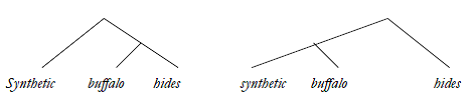
- Syntactic knowledge goes beyond being able to decide which strings are grammatical and which are not. It accounts for the double meaning , or ambiguity. For example in ‘synthetic buffalo hides’ can be grouped in two ways:
– synthetic buffalo hides which means “buffalo hides that are synthetic,” or
“hides of synthetic buffalo.”
Synthetic (buffalo hides) à We can get first meaning.
When we group like this:
(synthetic buffalo) hides à we get the second meaning.
Part of the syntactic component of a grammar is the specification of the syntactic categories in the language, since this constitutes part of speaker’s knowledge. That is, speaker’s of English know that item a, b, c, f, g and i in (2) are Noun Phrases even if they have never heard the term before.
(2) (a) bird
(b) the red banjo
(c) have a nice day
(d) with a balloon
(e) the woman who was laughing
(f) it
(g) John
(h) Went
(i) That the earth is round
You can test this claim by inserting each expression into the context Who discovered ________ ?” and “ _______ was seen by everyone.”
Only those sentences in which NPs are inserted are grammatical, because only NPs can function as subjectsor objects.
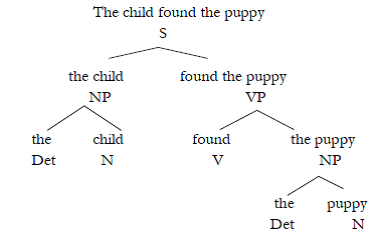
- There are other syntactic categories. The expression found the puppy is a verb Phrase (VP). In (3), the Verb Phrases are those that can complete the sentence “The child ________ “
(3) (a) saw a clown
(b) a bird
(c) slept
(d) smart
(e) smart
(f) found the cake
(g) found the cake in the cupboard
(h) realized that the earth was round
- Inserting a, c, e, f, g and h will produce grammatical sentences whereas the insertion of b or d would result in an ungrammatical string. Thus a, c, e, f, g and h are Verb Phrase.
- Other syntactic categories are Sentence ( S), Determiner (Det), Adjective (Adj), Noun (N), Pronoun (Pro), Preposition (P), Prepositional Phrase (PP), Adverb (Adv), Auxiliary (Aux), and Verb (V). some of these categories have been traditionally called “parts of speech”
2.5 Phrase Structure Trees
- The fact that The child found the puppy belongs to the syntactic category of Sentence, that the child and the puppy are Noun Phrases, that found the puppy is a Verb Phrase,, and so on, can be illustrated in a tree diagram by supplying the name of the syntactic category of each word grouping. These names are often referred to as syntactic labels.